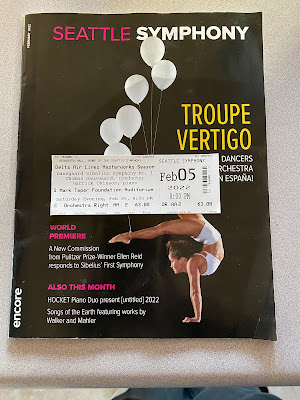
Saturday, February 26, 2022

To the Symphony!


After two longs years, we made it back to Benaroya Hall to hear the symphony in all its live, right there, glory. There's something about the experience of live music that transcends all other attempts at its replication. 

It just doesn't.

I've been around long enough to have listened to music, of many genres, in any number of delivery systems, from the single ear pieces that came with transistor radios, the kind we'd surreptitiously hide in our pockets—both for the racy music of that time, and because other activities thrust upon us like school and church were boring and having an earpiece, even if it was a cheap one, made us feel like a spy or secret agent—to lots of high-end stereo systems... and everything in between, from boomboxes to Walkmans of every variety (I wore out at least 5 over the years.)

But none of that compares to being right there. Not only hearing the music, but being a part of its creation; its performance. Real people playing real instruments in real time. There's the quiet, the light, the surges, the bombast, the nuance; the great talent and ability to play Rachmaninov, in this instance Garrick Ohlsson, playing the piece from memory. He followed that with an encore, played to perfection, yet with the ease as if he were at the family piano—assuming yours is a concert grand.

The main work was from Sebelius, as well as a new work, commissioned by the Seattle Symphony Orchestra, from Ellen Reid, titled, Today and Today and Today and Today and Today and Today and Today and Today and Today and today; her ode to the joys of pandemic living. 

And it was wonderful.

Even the ride down of the lightrail train, brimming with riders and the sounds of life, added to the experience. It was good to be out, masks and all.

©2022 David William Pearce

Saturday, February 19, 2022

The End is Only the Beginning...


Here we are at the end of our journey!

Well, sorta... almost. There are a few things left to do... assuming you want to.

This is the last I'll harp on the subject, and it's at this point where if you're serious, or just interested, you move into the realm of copyright and representation, so far as your establishment as a composer, writer, owner of salable materials, etc. It's here you encounter entities such as the copyright office, PROs (Performance Rights Organizations) such as ASCAP/BMI, which collect payments when your music is used publicly, and  SoundExchange, which collects digital performance royalties. There are also sync licenses, which are required if you want your music used in movies, TV, commercials, and games

Copyright

This is registering your songs with the government, allowing you the means of seeking redress in the courts if the need should arise. With most people it won't because the only time courts get involved is when big money is involved, otherwise it's not worth the cost of lawyers and the rest. I registered my works because I wanted there to be a permanent record of my songs. That way if someone wanted to hear them down the road, there'd be a place to find them.

ASCAP, BMI, SoundExchange

These organizations are tasked with making sure you get paid for your songs if you put them out into the public market and they are performed. ASCAP and BMI are for songwriters/composers whose works are used, SoundExchange is the collection of royalties from digital works, and who collects is based on who owns the rights to those songs and performances. If it's just you, it's not too complicated. Remember, I said not too...

Metadata

Metadata is all the information about the songs, from who wrote it, who owns it (this comes up when labels are involved), who performed on the recording and played what, who produced the recording, where it was recorded, how long it is, along with obvious things like title, performer name, date recorded, etc. This is incredibly important of you have visions of hearing it as a sync. It's also very important in dealing with PROs and SoundExchange. And don't think that just because whoever you distribute with helps out that everything gets out correctly. I've spent many delightful days cleaning up errors with my accounts. I have spreadsheets for all that which I highly recommend you have as well. That's life.

But wait, There's More!

Last, but not least, is how much time, energy, and most importantly, money you going to spent to let the world know about your great new release. There's a whole wide world out there ready, willing, and able to help you with this... for a small fee. I'll leave that to you. Just be careful about your expectations and ROI (return on investment).

That's some of it—there's always more. Hopefully, this helps a little.

©2022 David William Pearce

Friday, February 11, 2022

Let It Be


 The first Beatles album I bought, was a copy of Let it Be from the cut bin of a long gone record store in the Arvada Plaza in 1972. It was not my start with the Beatles; like most of us present at that time, I heard their music on the radio from I Want to Hold Your Hand on. In the years that followed, I bought most of their albums and listened to them at length. I'm certainly not unique in that aspect. I've watched their movies and TV appearances with one exception: Let it Be, which, by the time I wanted to watch it, had been given the kibosh by McCartney, who hated it.
Now there's Get Back, Peter Jackson's re-edit and enhancement of the Let it Be film.
Like most fans, I found it very interesting, though for reasons that might surprise. 

If you've read the many missives on the show, you'll note how many people were surprised that the Beatles got along. It has been taken as gospel that by then they were at each others throats and it's why they broke up. Mostly, though, other than when George left for a short time, they seem to be on good terms. And it's apparent they had a very good time playing together. But the gloom is there for anyone looking; it's just parsed out by the better time they had working through the songs. For those fans and Beatleheads cheered by the affability shown, it's proof of...

The fact that, reduced to four guys who grew up together playing music, it's a way to see them for how they were when just the music was on the table. Everywhere else, when they were "THE BEATLES," it's obvious how heavy it wore on them. The whole Let it Be project was a way for them to get back to their roots, before they skyrocketed to fame, before everything became bigger and more important and significant.

The irony, for those looking, is how hard that had become, and why they inevitably broke up. They broke up because being "THE BEATLES" was unsustainable. If you pay attention, all the big issues within the group come up: Who should manage? Should they play live, do concerts, or are then just an album band? And if just an album band, should it be like it was when they were fab, something Let it Be tried to recreate, or like the White Album, where everyone works on this and that, playing on their track, but not necessarily together?

It also answers the one big question everyone who harbored a hope they'd get back together had: Just think of all the great music they could have made? Within the show, you hear them playing snippets of songs that later turned up on their solo records, which means that we've heard all the songs that might have been on a Beatles record. Maybe not exactly as we heard them, but then again if you listen closely to Abbey Road, their last actual album, you hear all of the subsequent song stylings that turn up on their solo records. There's nothing we would have missed.

The ugly truth is the music business is hard. Watch any documentary on successful bands, and that always emerges. To project upon them the idea that should always be the 20yo mop-tops from Liverpool is fantasy.  As Lennon himself said: "The Beatles were what the Beatles were... The Beatles gave everything they've got to give and more, and it exists on record. There's no need for the Beatles—for what people think are the Beatles (emphasis mine)—the four guys that used to be that group can never be that group again... "

This isn't to say I didn't enjoy the show; I enjoyed every minute of it. It showed their talent, their work ethic, their knowledge of music, and their legacy as a cover band learning the ropes and using it to inform their music later on. It showed their joy at making music together. 

As a note to that, I highly recommend listening to Let it Be... Naked, Paul's realization of what the album was meant to be. It's the five of them, Billy Preston being the fifth, playing together, straight up. No Phil Spector ornamentation. Like all of their work, it's a very good album. And having watched Get Back, it rings true from first note to the last. 

*Musician Magazine 3

©2022 David William Pearce

Thursday, February 3, 2022

Now in the End...Part 1


 The hard work is done, I say with some satisfaction. Only took 3 years. 

As the last 4 posts have covered, I got the songs written, and recorded, and put in an order that I think makes them work well with one another; a nice flow from beginning to end. And isn't that what we all want?

The bigger questions come next, the biggest being: are you going to release the songs for distribution? This is different that passing out thumb drives, or sending out audio files to friends and relatives. This is creating artwork, having physical copies made, if desired, and finding a distributor.

We're now in the business end of things.

Artwork

Gotta have artwork. Just do. It can be a simple photo with a title across it. It can be a full-fledged work of art, something you create or have created by an artist. And it must be large enough, by pixel, to meet the requirements of many of the places you may choose to put it out for you, otherwise it'll look terrible. 

Physical copies

This can be CDs, good ol' vinyl records, labelled thumb drives. The companies that make them will need artwork of commensurate quality, they'll decline it if it doesn't meet their requirements, and hi-res audio files: FLAC, ALAC, WAV, AIFF, and DSD. No mp3s. You'll need these for copyright, as well. Vinyl has its own issues with required mastering and wait times given the upswing in interest. You'll also need to make sure your songs will fit. Welcome to the good old days.

Distribution

You'll need this if you want your music on Spotify, Tidal, Deezer, Apple Music Amazon, YouTube, etc. Companies like Distrokid, CD Baby, Tunecore, Ditto, Record Union, and many more. I went with CD Baby basically for simplicity and that they have a one time charge and cover nearly all of the streaming services. But that's just me. Yes, they take a cut.

Head hurt yet?

Don't worry, there's more. We'll look at fun things like ASCAP/BMI and Sound Exchange and copyright and Bandcamp in our next exciting installment.

©2022 David William Pearce


Wednesday, January 26, 2022

The Beginning of the End...Part 4


Let's Put This All Together

The songs are done. Alright. Is that it? Are we done? 

Heck no.

So, now what?

The next great adventure is setting the songs in order...assuming you have any interest in that. And, believe it not, it is a part of the process of putting a record out. I know this because I've read enough articles and interviews with bands and artists over the years discussing just how and why they put this song here or that song there to know that it's a part of the game.

And, it can be a lot of fun. Why? Because you get to listen to all your great new songs over and over again (this doesn't count the many times you went through them while recording and mixing and mastering).

The album playlist, the order in which the recording are played, assuming the listener plays them in order, is fairly important as it defines the flow the album will take when listened to. Do you want to get out of the gate fast? Then begin with a flashy number—one that sets the tone; think Hells Bells on AC/DC's Back in Black. Or maybe there's a song that defines the mood or theme of the album, say if it's all about love or a sign of the times. Maybe it's just a party album and you want the groove going right out the door.

Once that's set, lay out all the other songs and see how they fit together. If it's a CD or straight to Soundcloud or Bandcamp there's no need to find a break to flip over the record. (I never thought that would come back into vogue, but...people are buying vinyl again. Just don't know if they're actually spinning the records on a turntable.) Decide what goes where. The best way to work this out is to move them around and find what sounds best to you. Like I said, you'll be listening to the songs a lot.

Now if every song sounds the same, put the best one first—that's your single.

Next is artwork

This I leave up to you. Just make sure it's big enough and available in the right format. We'll get to that when we send it out and if we decide to have physical copies made.

©2022 David William Pearce


Friday, January 14, 2022

The Beginning of the End...Part 3


Recording

Because we live in the era of recorded music, it seems the logical endpoint is to want your songs to have a recorded version. Something to play for those who might want to hear it, in all its sonic glory (hopefully). Something to be remembered by. 

Then there's the nuts and bolts of it, which most songwriters and performers are unfamiliar with. The good ol' tech stuff.

Me, I record my own music. I do it because in the beginning I couldn't afford to rent time in a studio. 10 grand was a lot of money, and still is. So I got a 4-track recorder and over time taught myself how to make a decent recording. These days I have a 32-track digital studio (Tascam) on which I work my magic. I have outboard gear and pedals that I run the mics and instruments through; guitars, keyboards, and drums to perform on (I don't program the sounds mainly because I haven't taught myself to, and I'm reasonably proficient as a player so I shouldn't need to). 

The Process

Once I have to chords and lyrics to a song, I create a scratch track of the main instrument, which for me is either a guitar or a keyboard, and one for the lead vocal. From there I put together the song. Usually at that point I have a good idea of how I want the song to sound, which additional instruments to add, vocals, and the like. For the most part I get what I'm going for, but also I find that which I did not expect, which is the beauty of experimentation. Frustrations happen, but as you work through it, good things come through. Some might find this a fascinating process, others bored to tears. Playing the part requires you getting a clean take without mistakes, which sometimes means multiple takes. And every blue moon you get to the end of recording the parts and realize it's not going to work and you have to start over. I've been fortunate that that hasn't happened too often.

Pretty exciting, huh?

Like I said: nuts and bolts. How long a song takes is usually dependant on how simple or complex the arrangement. A guitar and vocal generally go quick. Multiple guitars, voices, keys, percussion, take more time and make mixing a more time consuming affair.

Mixing/Mastering

Mixing is putting it all together into something that sounds great, which isn't as easy as it sounds—exactly. It's like officiating: do it well and no one notices; do it poorly and everyone complains. I personally go for clear and clean, rather than loud and compressed, which often lends itself to muddy thick recording or all low end, some high end, and no real middle. 

I record with the mix in mind, meaning I add whatever effects directly to the track when recording it. The only variable then when mixing is reverb, which I do through the board so it can be adjusted in the mix. This makes the mixing easier because you're basically panning (moving the sound left and right) and setting track sound levels, while not also trying to find the right effects as well. Mostly this is because I don't have a beautiful Neve mixing board and a big room of outboard gear. 

Mastering is a fancy term for setting the right amount of compression across the entire song versus individual tracks after setting the final mix. I'm not a fan of all the massive compression found in pop and rock music these days. I run it through a standard program that's part of my recorder.

If you've gotten this far and haven't fallen asleep, congratulations. Like I said, nuts and bolts.

Next, making sense of what you've got.

©2022 David William Pearce


Monday, December 27, 2021

The Beginning of the End... Part 2


In the beginning was the music, and mostly, it was good...Got to have the songs to do anything.

The Music.

We all approach how we write our songs in our own way, to state the obvious. For me, the music always come first. It's possible that I've written a song from a lyric, but if I have I don't remember it. The music comes to me mostly in my head: I'll hear something (music is always dancing around in my head) and try to replicate it on the guitar, or every blue moon on a keyboard. Sometimes it comes from goofing around while I'm practicing other music and my mind wonders. This happens often. Sometimes I'm playing through a cover and that sparks an idea. I also tend to write in batches and have unfinished songs sitting around as I work through the other songs I'm recording.

It was in these unfinished songs that I went from Whispers (From a Forgotten Memory) to This Wonderful Life, with Winter in the middle. 

Organizing songs.

Since the early 80s, I tend to organize the songs I'm working on around a common theme, and having written 2 albums, We Three and Whispers, around the personal and intimate, I wanted to work on something else. I wanted to talk about the world we live in, as I had in the late 80s and those times. (Remarkably, or perhaps not, little seems to have changed.) Some of this was started when I was asked to write a song for a benefit to support homeless mothers and their children. I don't generally write to spec, but it's good to challenge yourself periodically. What came out was A Mother's Arms, and it was the spark that got me moving.

I know that most of the people I associate with in the songwriting community are not recording artists (a somewhat pretentious term, but that's how I see myself, as recording is what I focused on most with my songs), and because of that, I always hear the songs arranged with multiple instruments as I work on them before I ever start recording, and being a DIY guy since the 80s, it seems perfectly natural to do this.

Consequently, all these songs were taking form in my head as they came to me, and it was as that point that I decided to push myself to create a kind of musical journey (more possible pretentiousness) that drew from all the years of listening to and making music. I wanted to, in a sense, memorialize the music of my life—to create my part in all the music that I'd loved over the years. In this instance, I tried to structured the songs based on the genre they came from, whether they would have definable verses, choruses, and bridges.

The lyrics.

For the most part, I'm a terrible procrastinator when it comes to lyrics. Songs will sit around for months before I put any words to them. Mostly because I want the lyrics to mean something. Some songs are just for fun, are meant to be simple; there's no need for them to be anything beyond that. Dance music is like that: it's meant to be danced to, you're not going to spend any length of time listening to them with headphones in order to really understand the song (think the difference between a disco tune and a Dylan tune). I like lyrics that can be read with many meanings, but in the simplest way. I think for the most part I've succeeded. This Wonderful Life is full of these kind of songs. I also like the music and the lyrics to work together, I want the mood the music creates to inform the feel of the lyrics if that makes sense. 

All together now.

Once the songs have a musical structure and lyrics, it's time to record.

©2021 David William Pearce


Monday, December 20, 2021

The Beginning of the End...Pt 1

I've found that often I have much I'd like to say, but don't say, mostly because others are already saying it—probably better—and my two-cents will go unremarked. And as I have other outlets for writing what falls into my febrile mind, this blog often goes quiet for longer periods than I'd like. So maybe it's time to let go, save for a last hurrah.

Which got me thinking...

As the above photo illustrates, I have a new album, This Wonderful Life, that will be released on January 7th.  In the following series of posts, I'm going to bring you along this mostly solitary endeavor (which is of my own making, which I'll explain later) from starting to finishing.

I'm doing this mainly as an exercise, to share what I've learned over many years. We'll make a record, have physical copies made, copyright the album, register it (or more precisely make sure it gets registered) with publishers and PROs, in my ASCAP, as well as SoundExchange, so that whatever revenue the songs produce, I'll get my cut. 

Part 1.

In the beginning was the idea and the sounds in my head—and there are always sounds in my head. Having finished Whispers (From a Forgotten Memory), I rashly decided to start another series of songs about the world we live in these days—something I'd done with albums Apologia and Nothing Left to Say, among others. This was in late 2018. That it took more than 3 years is more a monument to my going in too many different directions and that the project itself grew as the years passed.

Initially, it was supposed to be 8 songs on social issues with the title of Primitive Desires, and the early songs, for the most part reflected that, but...

I was also working on Winter, an album of songs I wrote in 1984, that I had originally planned to record with a band in 1985. That didn't work out, but I'd always harbored the idea that I should record the songs proper-like. So naturally, it made sense to record those songs while I was working on This Wonderful Life. And as happens when you're working on two things at the same time, one inevitably takes over. I finished Winter in 2019, all the while continuing to write songs for This Wonderful Life.

I had 13 songs at that point, and again rashly decided to do a traditional double album, which to me meant two 8 songs sides, like all the dinosaur bands I grew up with and admired. Seemed appropriate. Anyway, with Covid slamming the door on all our use-to-be-normal get-togethers, I used the time to work on the songs, and I challenged myself to go for it, to push my limits of ability and gear.

In the end I did that.

Next: Part 2, the songs...

©2021 David William Pearce

Thursday, November 18, 2021

Ah, The Tangled Webs We Weave...

 I'll confess up front that I'm not a big Taylor Swift fan, and that's not a knock on those who are (less I get the Gyllenhaal treatment). However, having read about her performance on SNL of All Too Well, I decided to see for myself. It's quite a performance and I recommend any nascent or new to performing player to watch it closely.

As to the song itself, two thoughts come to mind. It's a beautiful song, particularly the lyrics, and as with all things musical, once out it becomes the providence of whoever is drawn to it. 

The song is an ode to a failed romance and the poor way in which the singer, Swift, is treated by her lover. A young woman, deeply in love with a cad, who is cavalier with her feelings and those of her family. The music is fine but it is the lyrics, and Swift's delivery of them, that cut to the bone. They are that good. The ache, the longing, the heartbreak, the anger; it's all there. So it's easy to see why people, particularly her fans, which I'll hazard are mostly women, see themselves, or their experiences, in it.

That brings up the second part. Obviously, the song is Swift's: it chronicles an episode in her life that was to her very profound (I assume). This is evident in her delivery; there's no need for theatrics, it is simply her channeling her grief and anger (again, I assume). It is then remarkable, though probably expected, that her fans would take it upon themselves to excoriate Gyllenhaal (as well as his family and friends) for his treatment of her. I find this deeply ironic because there's no way they could top Swift's lyrics in its dissection of his behavior.

This brings in another point: since so many people don't actually know either Swift or Gyllenhaal (including me, hence the notes above), or have any first hand knowledge of their relationship 11 years ago, everything that impresses or offends them is of their own making; their own projection onto this pair that dated for a few months in 2010. Fame is an elusive thing with many wanting it and few finding it. Swift's song gives the listener all they'll ever need to see it as they want to: either of her and her honor (I suppose) or their own. It also seems pretty obvious that Swift doesn't mind her fans taking the ball and running with it. Whatever happened between her and Gyllenhaal, which she herself neither confirms nor denies, is left to the imagination of those who identify with it. For good or for bad.

I bring this up because I have a song on my latest album that talks about the freighted relationships we have with our musical idols, about how invested we become in them even as we know so little, truly, about them; that it is purely a projection, upon them, of how their music affects us. Consequently, I find the topic fascinating.

©2021 David William Pearce

Sunday, July 4, 2021

To Perform or Not to Perform...


As we ease on down the road out of perdition, however cautious or foolhardy, for musicians and performers the question arises: will you or won't you?

Odd as it may seem, some are reluctant after so long a break. Including me...which I'll confess I find surprising. I'd gotten into a pretty good groove prior to the pandemic. At least 1 open mic a week, sometimes 2, hosting and open mic once a month and having people over to play—I was setting up to host house concerts. That all ended rather abruptly. Naturally, it was assumed I would also play, which I did.

Will I now?

It should be a no-brainer. I have a new album that'll be done soon. Songs I released last year that I haven't had a chance to play for people. And all the songs I played before. If they were good enough then...

Still. Many are itching to get back out there. One assumes that the line will be long at restarted open mics, showcases, plain old shows, with all of us there to listen and play, working out the kinks and cobwebs and getting back to our old selves.

Except our old selves we left back in March of 2020.

And maybe that's part of it.

Having performed in the past in a certain contained way, I have the desire to open up, be free, all that old hippie vibe stuff, except there's always the fear of not getting it right, to not pull it off, and while I'm old enough to know that I don't have to prove anything, I don't want to get it wrong, or, even worse, just blow through it.

So, we'll see. 

First I have to finish the album.

©2021 David William Pearce

Wednesday, June 2, 2021

Same As It Ever Was


I was reading an article on the Black Keys recently. They have a new album out, one where they've recorded some of their favorite blues tunes. This is not a new phenomena, in fact, it has been around for 60 plus years, most notably during the British Invasion, when young English white dudes presented American Blues right back to us.

The irony was noted then, as it is whenever articles like this come out.

Now before you get tight with me, thinking I'm dissing on the Keys, the more interesting part of the story is the Keys fear that the blues, in particular southern rural blues, will be extinguished from the good earth due to an antipathy to it by the general public, and its apparent preference for good ol' generic pop, pumped out by photogenic youngsters who are typically white, but not always. (Ironically, this dismisses Rap, which is still predominantly black, and perhaps surprising to some, more popular than...pop!)

I'm shocked.

Fortunately, I've been shocked—but not really, as I've been hearing (but mostly reading) this for most, if not all, of my lengthening life. Southern rural blues, like R&B, Americana, which is real country music, Bluegrass, Jazz, have been given last rites only to live on in the communities that love them. Granted, these communities are not large until you put them all together, and then you see that all music outside of that which is considered commercially viable—read the stuff you're going to hear on TV award shows, is substantial. We're just not getting rich off of it.

That includes all of us pining away locally.

Perhaps the most fascinating part of the article is how the life of a song changes over the lives of the people who keep the songs going. In some respects it is this that keeps and will keep all the genres of music alive beyond that heard by teenagers, and as we have all been there, let's not harsh them too badly.

In fact, the beauty of being little known is that the songs are allowed to change with time, with different performers in different places and with different instruments and interpretations. The rigidity of well-known songs by specific performers—think of every concert you've gone to by acts from your youth—is, inevitably, once they're past their prime, nothing more than a replay of their greatest hits, over and over again. Fleetwood Mac is not going to completely reinvent their catalog because they've done it the same way for 50 years and are sick of it. (This is why Robert Plant has consistently squashed every hint at a Zeppelin reunion.) Fans would not pony up megabucks to hear the songs played any other way than how they remember them. That's not a problem in the rest of the music world. Mostly... I'm looking at you, Beethoven fans.

And while we all harbor a secret, or not so secret, desire to make it big and be bored that our back catalog is what's keeping us going, we still get together, write, perform, and enjoy because it's in our natures to do so. 

For those of us who just want to play, we play, and often we tweek, or change, or rearrange, and it's all good, and it'll never leave us.

©2021 David William Pearce

Sunday, May 23, 2021

All Hail the Hobbyist


As a rite of spring, or any other season for that matter, blossom those for whom opprobrium is manifest in declaring who are the true professionals and who are the mere hobbyists. Like a fine muscatel, each year produces another screed upon which those of us who aren't yet important enough to declare our ever move, personal or professional, super important and the necessary glue holding society together, must confront the very nature of our musical and artistic credentials.

Most important indeed.

Two things are, naturally, fundamentally intrinsic to this: money and suffering.

Most of us are convivial, if not occasionally troubled, by the first, and lacking in interest in the second. Consequently, it is framed as paying dues, doing time, and struggling for an admired goal. Nevermind the near astronomical odds of actually "making it." We can dream. And many do. Many also come to the realization that for all their hard work and perseverance, they will never achieve their dreams of being big in the business, at least not as the main act.

Many do stay in the business, but as something else-mainly to help those who still harbor the dream of big things to come. And someone has to fill those occupations that aren't as glamorous, but certainly vital to the machine, such as record execs, PR shills, and the A&R people, assuming they even exist anymore.

As you may note from the tone of this, the idea that only those who spend their lives living hand to mouth, filling odd jobs, and hoping that a health crisis doesn't bankrupt them or worse, are the true professionals, and all the rest of us hobbyists, is the usual tinfoil hat that keeps artists poor and working for "exposure" rather than a decent wage.

That doesn't mean not going to open mics or booking gigs, however much or little you make. The machine does require a dogged perseverance if you want a certain kind or level of fame, just don't be surprised if even after all that, you're still making most of your income from waiting tables, or God forbid, working a mainstream job.

Most art isn't going to pay the bills. Sadly, it probably never will.

And if you feel the need to say that because I choose to go a different route (and I have been paid for my work) I'm just a hobbyist, knock yourself out. I'll still come hear you play and wish you well, having been there.

©2021 David William Pearce


Friday, May 7, 2021

The Terribly Exciting World of DIY Recording


I often feel the need to pontificate on the "joys" of Do It Yourself (DIY) recording. I don't know why, other than some perverse need to bore people-though, I must say, there are those who, remarkably, find this all somewhat helpful. That, and it justifies the many hours I put into making music in the first place.

The beauty of DIY is total control. No pesky producer or engineer poo-pooing your cogent insights or desires to make what you're certain will be a timeless addition to the world's greatest music.

And in this period of quazi-quarrantine, the opportunities to hole away in one's hovel (see above photo) are plentiful. Being mindful of this, I have been dutifully working through my late-life magnum opus-what used to be the double album when records were the dominant means of entertaining the music listening masses. 16 songs and 2 chants, one to open the record and one to close it.

Why would I choose to do this? Don't ask.

I also felt the need to challenge myself as far as how much I could get away with, whether I had the talent to pull it off or not. That invariably brings up what to play on what instrument in what time and what key on what song. The benefit and curse of having more than one guitar, or instrument, is working through this one and that one, hoping the answer would present itself.

Fortunately, it often did.

Having a home studio also allows those of us who work slowly to do so without going deeply in debt. And with the advent of digital recording, you can record and re-record to your heart's content, or until you run out of space on your hard-drive (and no pesky generational degradations that you use to get with tape, not to mention the warehouse you'd need to store all those reels of tape). This is good and bad. Good that you can work through idea after idea, and bad, when after idea after idea, you're still not happy or even close to finishing. I call this the Peter Gabriel dilemma, as he was known to tinker and tinker and redo to the point of his producer's distraction.

Sometimes this leads to making tough decisions and completing projects or lots of started but never finished ideas. Personally, I have an abhorrence to not getting all my brilliant ideas out there where they can be ignored en masse. 

Which allows me to solder on.

©2021 David William Pearce

Monday, April 12, 2021

Long Dead, Like New


Believe it or not, there's an AI program that creates new songs by dead artists because isn't that what we really want: bad, fake Kurt Cobain songs.

Now I could waste the next few minutes of your time pontificating on the value of such an enterprise-as the articles note, this was done as an example of "what if" they, Cobain, Hendrix, Winehouse, hadn't died early-but I think what's more interesting, at least to me, is how this could help aging types, like me, milk out more songs, that quite frankly might be better than anything I could come up with myself.

In fact, think of the potential across the musical board!

Why waste time trying to recreate a particularly period in your musical history when you can get your computer to do it for you? Sweet, huh? Some of it might even be sorta, kinda good. A bonus. Because, let's be honest, writing and crafting a new song is a lot of work, and sometimes it goes nowhere, or even worse, you get it half done and can't figure out a workable bridge, or that last verse, etc. It can be too much!

Bring on technology!

Now some of this requires enough source material for the AI program to actually produce more songs in the idiom you're looking for, without reproducing the same song many times over because it's got only 2  or 3 source songs to work with. Probably not worth the cost of the program, assuming it doesn't cost a fortune to begin with, which assumes you have a fortune to dispense.

If you think this is hooey, well, good for you. All crafts need those hard-nosed types, face to the grindstone, spending untold amounts of time eking out a song now and then, and for what? But for all the rest of us, pressured by the flacks of modern social media, who demand that "content" be pumped out week after week, month after month, year after... well, you get the drift. It's all too much. It's quantification over quality, assuming that matters at all anymore.

So I say, if computerization got us into this mess, it can help us deal with it.

©2021 David William Pearce


Friday, February 19, 2021

Is Rock Like Jazz Like Classical


Recently, the 250th anniversary of Beethoven's birth was celebrated around the world by those who have an affinity for the man's work and his place in the classical canon. (More amazing, to me, is that in 6 years it will be 200 years since the death of Beethoven and we still celebrate his work.)

It also brought out those who are angered by the predominance of dead white males in Classical music-which is somewhat odd as Classical music is mostly European in origin (Meaning what else would it be?). This isn't about that, though I will say that rather than bad-mouthing Ludwig Van, it might be better to actually schedule and play compositions by those commonly left out of the repertoires of leading orchestras.

But what I really find fascinating by this regular occuring hubbub, is that it's beginning to play out in Rock, just as it has in Jazz, which had its heyday in the first 70 years of the 20th century. There are the titans of Rock and everyone who followed. With the deaths of Eddie Van Halen, Lemmy Kilmister (Motorhead), and others, the pantheon of the Rock-n-Roll era continues to pass into history. The question then becomes will anyone take their place or like Beethoven, Mozart, Bach, etc., will they forever be the standard and the iconography of Rock music?

This isn't an idle question. Name a single recent rock band. If you can, can you say they're distinctive enough to stand out against what we've set up as the Rock standard? And if you think this is bunk, think of Jazz and how anyone coming up is inevitably compared to the titans of Jazz, be it Armstrong, Ellington, Parker, Coltrane, or Miles. Every genre has its glory period, and the greats of that period, whether you like it or not, dominate.

For those of us so blessed to have grownup with and seen, live and in person, these bands and performers, it is, in some sense, our gift, just as it was for all those who first heard something new and vibrant in classical music and Jazz. And it's hard to deny their place when their music, now some 40-60 years old, is still being played and the artists continue being venerated by young people, not just us geezers. That doesn't mean they always will; all greats go through periods of diminishment and reassessment, as Ludwig Van did, but he never went away and the quality of his works remains.

 This doesn't mean people won't continue to play and write within the rock idiom and all of its subgenres, I imagine they will, but I also think that for the foreseeable future, and perhaps beyond, the greats will continue to be the standard.

©2021 David William Pearce

Friday, January 8, 2021

An Obligatory Look Back


Ah, 2020, that you should go quietly into that good night. (I started this before all hell broke loose... so... but that's for another time and blog.)

Having not written anything in the couple of months for this blog, I wondered if an end of the year navel gaze was a good idea. Aaaa... sure why not.

In normal times, I would brag about everything that was accomplished-and there was some of that-as well as all the good times that were had throughout, though after March, there was not too much of that. 

Mostly.

I had big plans, but most of us did that did not come to pass. Concerts, open-mics, even general get togethers were canceled or replaced by Zoom meetings, which are not terribly conducive to good sound, not to mention the human qualities of being "in the room" when there is a performance. Again it's what we have at our present disposal.

On the plus side, I released the last of my "legacy" albums, Fingers in the Air ('85), No Love Here ('86), and Nothing Left to Say ('91), which means that all that fit to release has been. I've also finished half of the upcoming album, This Wonderful Life, which I hope to complete and release sometime this year.

In addition, I helped with the recording of songs for Joy Taeko, and Benny Lee. They came out quite nicely such that neither Joy or Ben have disparaged me terribly.

I would like to believe that 2021 will be something to behold, though I'm not holding my breath. And I'll hold off wondering if all this is an utter waste of time. This is a honored tradition for those of us yet to hit the big time. Those who have, spend their time trying to stay hip and relevant, as well as selling some or all of their catalog now that their revenue streams have gone off the road into a ditch.

I, fortunately, do not have that problem.

My problem is how much time and effort to put into this, which might sound somewhat defeatist (and I'll cope to that), but that is going to come (and hopefully go) as one does these creative types of things. Maybe it's just the product of a difficult year. Only time will tell. 

I'll ponder that as I try to make good in my other life as a writer of scintillating mysteries

Because if there's one thing we all know, it's how easy it is to make it big in the entertainment business.

Happy New Year.

©2021 David William Pearce

Friday, October 23, 2020

The Distant Past Comes Calling


Awhile ago, I foolishly admitted to still having old cassette tapes from the late 70s of me singing demos of songs I'd written. Like most people of a certain vintage, I have vague recollections of that time, some good, some not so good. This carries over to my memory of the songs themselves and whether they're worth the time and effort to review.

And paradoxically, it did take time and effort for all my cassette players, except for the one in my wife's car, no longer functioned. Apparently, not using them for years at a time comes at a cost. Something I'm especially eager to find out.

However...

As I mentioned, the cassette player in the car still works, no doubt because it's not nearly as old as my beloved Nakamichi LX-5. 

I don't even want to think about trying to get that fixed.

That aside, I bravely mustered the courage to listen to the tape, which was recorded in the Spring of 1979. It's a collection of songs written that Spring as demos for a possible album (3 of the songs ended up on my first album, PearceArrow). Surprisingly, I did not find myself aghast at my terrible-ness. That's not to say I found the experience super wonderful.

My tendency in those days to play a riff over and over was on full display, nearly every song is way too long (It's a demo, man; keep it short and sweet!). More than once I yelled at the machine to "Get on with it!" It also shows its age, lyrically and musically, assuming you have any memory of the 70s and the songs from that era.

On the plus side, it turns out the songs aren't terrible, and, other than me, were well received by those fearless enough to take a listen. We are talking about songs sung into a mono cassette deck, not something known for its aural fidelity. And I didn't think the songs were bad, per se, only that they were those confessional singer/songwriter type songs that now give me the heebie-jeebies. 

I know, I know; it's my problem and I'll deal with it.

The one question that does arise, beyond what I'll do with all these leftover cassettes if I don't repair the LX-5, is what to do with the songs. Let sleeping dogs lie, or produce a more stereophonic version (Minus the neverending riffing).

First I'll have to sit in the car and try to remember what chords I was playing.

©2020 David William Pearce


Monday, October 19, 2020

Remembering Eddie Van Halen


I can remember vividly the first time I heard Van Halen. I was at my girlfriend's house, when her younger sister told me I had to hear this new band. Van Halen.

Never heard  of them.

Another guitar band in the days when there were lots of guitar bands.

But the ugly truth, in those days, was that the big guitar heroes were all from the 60s: Hendrix, Page, Clapton, Beck. The other great guitarists you had to look for, because they weren't in heavy rotation on the radio. You heard about them from other guitar affectionados.

Then came Eddie.

It was quite literally like nothing else. To me it shimmered in intensity, in color, and in spirit. It shot you into the sky. 

It was easy to see that what he was doing was new, vibrant, and vital. Everybody knew it. It was lightening filling the sky, and it was irrepressibly joyful. Anyone who ever went to see Van Halen in concert got that right away: he loved to play.

To me, though, the part of his game that doesn't always get enough play is how his playing, especially in the band's recordings, always enhanced the songs. The songs weren't there for the benefit of the guitar; the opposite was true: the guitar was there for the song. The solos and the fireworks always enhanced the song, the recording, the performance. 

I think that's key.

My favorite Van Halen album was, by most accounts, their least successful, Fair Warning, as there were no covers and it's not really a party album. But it best distills the songs of Eddie Van Halen, as he was their principle writer, and how he integrated his guitar playing seamlessly into the songs.

And those songs and recordings will live on.

©2020 David William Pearce

Wednesday, October 7, 2020

Playing With Others


For the longest time, it was just me. After leaving Denver in '85, I didn't collaborate or play with others; I did my own thing. I knew other musicians and went to their shows, but collaborations and the like wasn't something I was either ready for or had time for.

I was a hermit, planting myself in front of my Tascam 244 and playing away. 

These days, these ever delightful Covid days, and the fact that there's nowhere to play, and may not be anywhere to play for some time, I returned, sort of, to planting myself in front of my Tascam DP32sd (the 244 ran out of gas years ago, though I still have it).

But I also, when we were allowed to form our small hermetically sealed groups of less than 5 or 6, decided to work with others or they decided to work with me. I forget. Some of this was due to my acquiring a Focusrite interface for my computer for Zoom meetings because the audio on Zoom stinks. A side benefit was it works really well with Garageband, which I hadn't used because I already had a study set up elsewhere and Garageband has its limitations.

But I found it's quite good for songs that don't require a lot of instruments or orchestration or any of that. And I had friends in our hermetically sealed group who wanted to make a few recordings. 

So we did.

And I had a lot of fun doing it since both Joy and Ben-the two people I was working with-write in different styles and it meant I'd have to adjust; and isn't that what life is about?

Feel free not to answer that.

So far it's turned out really well with 6 of Ben's songs finished, and 2 of Joy's in the works. We've finished 1. All in all, a good time and something to show for it.

You can hear one of Benny's songs at Benny Lee Country.


©2020 David William Pearce

Friday, August 7, 2020

Life Without Chickens


Life Without Chickens is one of my Favorite compositions. From the album of the same name, it is the longest of anything I've written, and is an instrumental. Consequently, it is the proverbial kiss of death in the sense that anyone will listen to it.

But I'm going to talk about it anyway.

Like everything else I did in those days-this was the mid-80s-it was the music equivalent of stream of consciousness. No working it out, no charts, no planning; just do it. Start with a drum track which had just been created on the Drumulator. Grab a guitar and play along with it. Or the bass guitar, which as I worked through the first part, there are 3 to the composition, I decided would be the connector between the 3. It was all very free form jazz, even though there are no horns on the recording. Mostly, it's the bass, 2 guitars, and a synth.

Perhaps the interesting thing is that it works. It probably shouldn't. I simply played along with what was there, or in the beginning, whatever I thought might be fun to play. Mostly, the framework was a series of open chords played over and over. Doesn't sound terribly promising.

Yet it works.

As I said in my last post, I don't get it. It just happens and weirdly it works.

The first part, cleverly titled: A Ticket in Bill's Shirt, which means nothing, came about as I was screwing around with the flute sound on the synth, A Korg Poly-800 for those so interested, and thought I should use it.

Part 2: Martians with Guns, features a distorted guitar lead, therefore the title. Makes sense, right? For whoever listens, note it follows no particular pattern like 12-bar blues. It takes its time, then fades out to...

Part 3: A Hymm to Life Without Chickens, is a wink and nod to Miles Davis. I was listening a lot to his albums from the 50s and early 60s and the lyricism of his playing made its way into the lead guitar that sings over the somnambulistic music rhythm playing beneath. I thought it was the perfect finish.

And because it is the absolutely most fatal way to start an album, Life Without Chickens, is the first thing you hear on the album, rather than the any of the other much shorter song that follow. I'm stubborn that way. It's also possible I'm the only person to listen to it from beginning to end.

Probably.

Which is too bad, because from a jazz standpoint, I suppose given its structure, it's quite good. Really. Honest. You'll see.

©2020 David William Pearce